
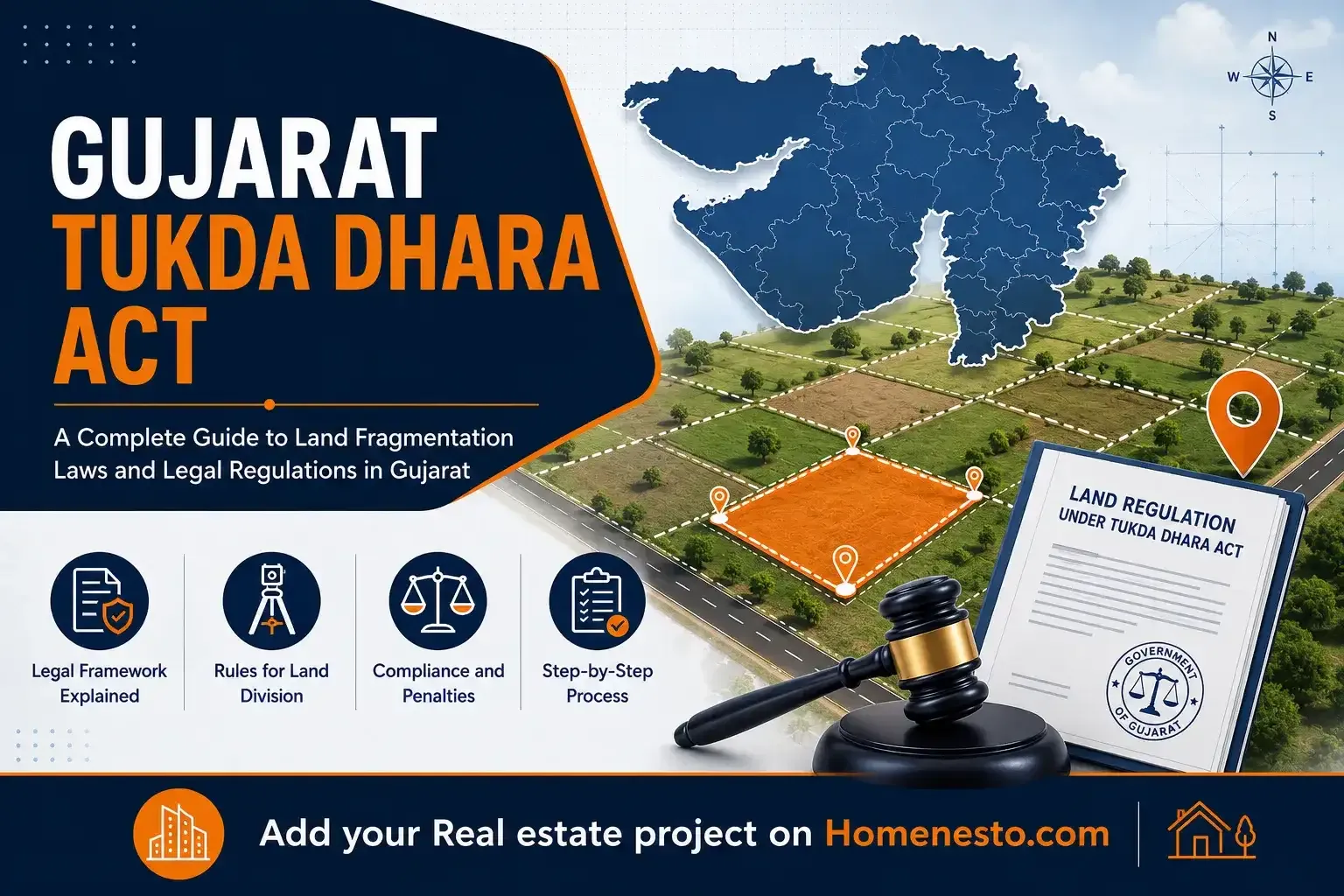
Gujarat's Tukda Dhara, a land law that has stood for 75 years, has just been amended. The Governor and the President of India have both given their approval, clearing the way for the changes to take effect. For farmers, landowners and anyone dealing in agricultural land in Gujarat, this is one of the more consequential land law updates in recent years.
What is the Tukda Dhara
Tukda Dhara is the common name for the Gujarat Prevention of Fragmentation and Consolidation of Holdings Act, 1947. The law was originally written to stop farmland from being split into pieces too small to farm productively. In practice, it also made it harder to sell, gift or divide small parcels of agricultural land, even in cases where families genuinely needed to.
Over 75 years, the rules around what counted as an illegal "fragment" differed from district to district. That inconsistency created a long-running problem: a large number of land transactions across the state technically broke the law, often without the people involved realizing it, or because there was no practical alternative at the time.
What has actually changed
The amendment addresses three specific issues.
1. Past violations will be regularized, without a penalty
Any breach of the Tukda Dhara from 1948 up to now will be regularized. No fine, no penalty. This is the part that affects the largest number of people, since it covers roughly 75 years of land transactions.
2. One rule for the whole state: 10 Guntha
Instead of different local rules for the minimum legal plot size, the state now applies a single standard: 10 Guntha, which works out to about a quarter acre, or roughly 10,890 square feet. This applies the same way regardless of district.
3. Urban areas are exempt
All urban areas in Gujarat are now fully exempt from the Tukda Dhara. The law was built around agricultural land, and applying it inside city limits had been slowing down non-agricultural (NA) conversions and construction approvals for years.
Who this actually helps
If you own agricultural land that was subdivided, sold in parts, or transferred in a way that technically violated the old fragmentation rules at any point since 1948, this amendment clears that up. You no longer have to worry about a penalty for something that may have happened decades ago, possibly before you even owned the land.
It also matters if you're planning to buy land. A good share of the due diligence delays around agricultural land in Gujarat came down to fragmentation issues buried in the title history. With old violations regularized and a single statewide rule in place, checking a land title should get simpler.
Developers and real estate businesses working in urban and peri-urban Gujarat benefit too. Getting land converted for non-agricultural use, and getting construction approvals afterward, has been one of the slower parts of any project. Taking urban areas out of the Tukda Dhara's scope should shorten that timeline.
What this means if you're buying agricultural land now
The uniform 10 Guntha rule doesn't remove the need for basic checks. If you're buying or selling agricultural land, you'll still want to confirm the plot size against the new statewide minimum, check that the sale deed matches the revenue records, and verify the land isn't tied up in a pending consolidation scheme. What's changed is that you no longer have to work through a patchwork of local interpretations just to figure out whether a transaction is valid.
A note before you rely on this
This article is based on the state government's approval reported in mid-July 2026, as covered by Sandesh and Gujarat Samachar. The full text of the amended Act, its effective date, and the exact procedure for regularizing old violations will be published in the Gujarat Government Gazette. If you're in the middle of a land transaction, or dealing with a specific fragmentation issue on a property you own, check the official gazette notification or speak with a revenue department official or a property lawyer before acting on this. News coverage is a useful starting point, not a substitute for the actual legal text.
Sources: Sandesh and Gujarat Samachar, both reporting the Governor and President's approval of the amendment in mid-July 2026. Verify against the official Gujarat Government Gazette notification before using this for a legal or transactional decision.
Here are the source links I used for this piece: