
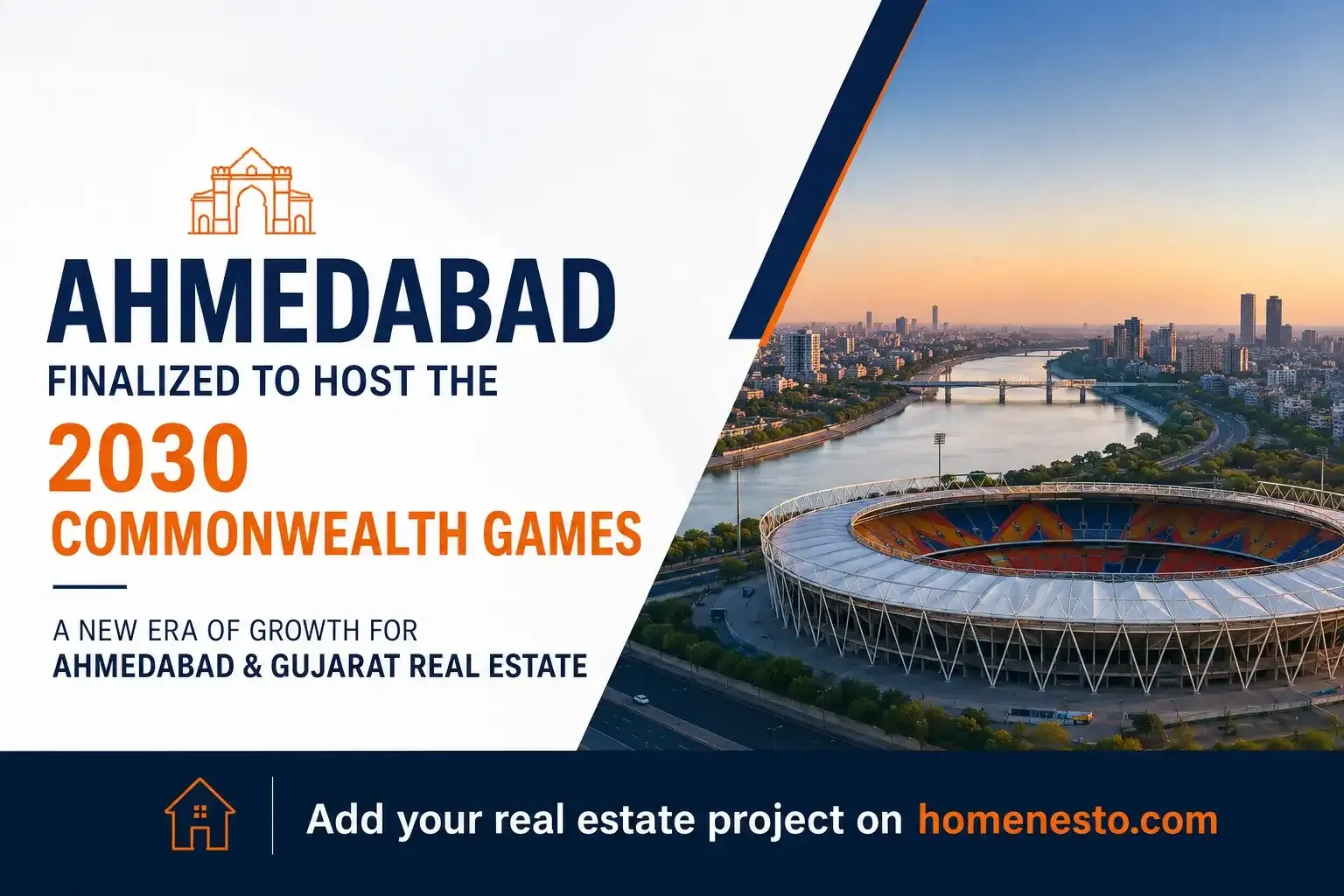
Gujarat's capital region has spent the last several months digesting what host-city status for the 2030 Commonwealth Games actually means on the ground. The confirmation came on 26 November 2025, when member nations of Commonwealth Sport meeting in Glasgow ratified Ahmedabad, officially Amdavad, as host of the 24th edition of the Games. It is also called the Centenary Games, marking a hundred years of the Commonwealth Sport movement, and it will be India's second time hosting after Delhi in 2010. The Games are scheduled for October 2030, the edition that follows Glasgow 2026 in the Commonwealth Games calendar.
An announcement like this rarely moves property prices by itself. What moves prices is the land acquisition, transit construction and hospitality investment that follows over the next several years, and that work is already underway across Ahmedabad and Gandhinagar. This piece looks at what's actually being built, what's driving the change, which parts of the twin-city region are seeing the earliest effects, and what a similar Games did to Delhi's property market back in 2010.
What hosting the Games actually involves
Ahmedabad's bid, put together jointly by the central government, the Gujarat government and the Commonwealth Games Association of India, leaned heavily on the city's record of hosting large events: the 2023 ICC Cricket World Cup final, regular IPL matches and the 2022 National Games. Commonwealth Sport has so far confirmed athletics, swimming, table tennis, lawn bowls, weightlifting, artistic gymnastics, netball and boxing, each with a para category, and says the final programme will run to between 15 and 17 sports. In April 2026, sports minister Mansukh Mandaviya said cricket and hockey would also be included, which matters here given the role the city's main stadium is set to play.
That stadium, the Narendra Modi Stadium in Motera, part of the Sardar Patel Sports Complex, seats around 132,000 people, making it the world's largest cricket stadium by capacity, and it will host the opening and closing ceremonies. Around it, a design team led by BDP, working with Cox Architecture and Collage Design, has released a 350-acre masterplan for the Sardar Vallabhbhai Patel Sports Enclave: an aquatics centre, an indoor athletics arena, tennis show-courts and an athlete village, laid out along a green boulevard that runs down to the Sabarmati riverfront.
Building it means acquiring land. The Gujarat government has started acquiring around 650 acres across Motera, Sughad, Bhat and Koteshwar, according to reporting from The Federal. Roughly 280 acres is earmarked for the new sports complex, 240 acres for the athlete village, and 50 acres near the riverfront for reception facilities. Notices have also gone out to three ashrams in the area to vacate around 140 acres. Some of this acquisition is still being negotiated, and it's worth tracking since it directly affects how much land near the venue becomes available to build on, and when.
The infrastructure factors that actually move prices
Metro connectivity
The metro network is the clearest lever here. Phase 2, approved at a cost of roughly ₹5,384 crore, connects Motera with Mahatma Mandir in Gandhinagar and includes a branch from GNLU to GIFT City that has been running since September 2024. In June 2026, the Union Cabinet approved a further extension, Phase 2A, from Koteshwar Road to the airport, and the government's own release ties this extension directly to preparation for the Commonwealth Games and the 2029 World Police and Fire Games. Once complete, Ahmedabad and Gandhinagar together will have close to 78 km of metro line. Localities that get a station tend to see faster resale interest and easier rental demand than areas that don't, and that shift usually starts before the line opens, not after.
The Mumbai-Ahmedabad bullet train
The high-speed rail line ending at Sabarmati is a slower but larger factor. Railway minister Ashwini Vaishnaw told the Lok Sabha that the Gujarat stretch, from Vapi to Sabarmati, is targeted for December 2027, with the full corridor from Maharashtra through to Sabarmati expected by December 2029, a year before the Games, according to Deccan Herald. The Sabarmati terminal sits close to the main sports enclave, so a working line would give Ahmedabad a direct high-speed connection to Mumbai right as the Games infrastructure comes online, assuming the timeline holds.
GIFT City's pull
GIFT City, the finance and technology hub between Ahmedabad and Gandhinagar, was appreciating well before any Games bid existed, and that trend hasn't slowed down. Data from 99acres puts residential prices there up 11.6 percent over the past year and 53.5 percent over three years, with average rates now around ₹11,000 per square foot, up from roughly ₹4,500 in 2020. Because GIFT City falls inside the twin-city footprint the Games are using, and already has metro access, it's one of the few areas where the Games effect and an existing growth story point the same way, rather than one creating the other.
Ring roads and the western and northern corridors
The Sardar Patel Ring Road and its planned extensions are opening up land that, until recently, sat too far from the city centre to interest most buyers. South Bopal, Shela and parts of the Bavla stretch are the clearest beneficiaries. Alongside them, the established western corridor of SG Highway, Prahlad Nagar, Thaltej and Ambli continues to hold the city's highest per square foot rates, largely for reasons unrelated to the Games, though better ring road access adds to their appeal.
Hospitality and short-stay demand
An event of this size brings a temporary but real spike in hotel and service-apartment demand. Ahmedabad's hospitality sector has already been tested by the 2023 World Cup final and regular IPL crowds, so this isn't an untested market. Developers and hotel operators typically respond to this kind of demand earlier than residential buyers do, which is why commercial land near the main venues and along SG Highway tends to draw interest first. If you're tracking this side of the market, Home Nesto's commercial projects in Ahmedabad listings are a useful way to see where developers are actually placing new commercial launches.
Where the activity is concentrated
Not every part of the city is affected the same way. The table below groups the areas seeing the most attention right now, based on what's actually being built nearby rather than general market sentiment.
| Area | Main driver |
|---|---|
| Motera, Chandkheda, Sabarmati riverfront belt | Direct proximity to the Sardar Vallabhbhai Patel Sports Enclave and the main stadium |
| GIFT City, Raysan, Randesan, Kudasan, Sargasan | Financial-hub employment growth plus existing metro connectivity |
| SG Highway, Prahlad Nagar, Thaltej, Ambli, Satellite | Established premium corridor with commercial and hospitality spillover |
| South Bopal, Shela, Bavla, SP Ring Road corridor | Peripheral land opening up as ring road access improves |
If you want to see what's actually listed across these pockets rather than just reading about them, Home Nesto's residential projects in Ahmedabad page lets you filter by locality and compare current launches directly.
What the Delhi 2010 precedent suggests
India has done this once before, and the outcome offers a mixed but useful reference point. Delhi's 2010 Commonwealth Games Village, built by Emaar across roughly 157 acres in East Delhi, held 34 towers and more than 1,100 apartments. After the Games, a majority share of those units were sold as private housing, and the area around it, close to Akshardham, has since become an established residential pocket rather than a leftover sports campus. That's the outcome host cities aim for: infrastructure and housing stock that outlives the event.
The run-up wasn't without friction. India's federal auditor later flagged cost overruns and delays across several components of the project in its official performance review, and reporting from that period documented land price increases across Delhi's Trans-Yamuna belt as roads, flyovers and metro links were pushed through on a tight deadline. Coverage from that period points to residential prices near the Games Village rising roughly 10 to 15 percent in the year before the event, driven mainly by transport upgrades rather than the Games.
Ahmedabad's 240-acre athlete village at the Sardar Vallabhbhai Patel Sports Enclave will likely follow a similar path once the Games end, though specifics haven't been made public yet. The broader pattern from Delhi holds: the transport and civic investment made for a two-week event is what sticks around and shapes long-term property values, and it tends to show up in prices well before the opening ceremony.
A few things worth checking before acting on any of this
The Games are still four years out, and several of the projects behind this story, the bullet train's full corridor, some ring road segments, parts of the metro network, have already slipped past earlier deadlines once. Treat every completion date here as a target rather than a guarantee.
GIFT City and the western corridor are also the most talked-about areas, which means they're the most likely to already carry some speculative pricing. It helps to compare a specific project's RERA registration and actual construction stage against its marketing pitch, rather than buying on the strength of the neighbourhood's reputation alone.
The land acquisition around Motera, Sughad, Bhat and Koteshwar isn't finished, and part of it involves disputes over ashram land and compensation that are still working through the system. It's worth following local reporting on this rather than assuming the masterplan proceeds exactly as drawn.
None of this is financial advice. A property decision built around a single event four years before it happens carries more uncertainty than the renderings suggest, and it's worth treating it that way.
The Commonwealth Games themselves will last a couple of weeks in October 2030. The metro lines, rail link and roads being built for them will still be there afterward, and that's really what's being priced into the market right now, not the event itself, but what gets left behind once it's over. For a broader look at what's currently available across the city, you can browse all real estate projects in Ahmedabad on Home Nesto.
Sources
- Commonwealth Sport — official confirmation of Ahmedabad as 2030 Commonwealth Games host
- Wikipedia — 2030 Commonwealth Games overview
- The Tribune — India's 2030 bid and Ahmedabad's hosting track record
- Archysport — sports minister's confirmation of cricket and hockey inclusion
- Building Design — BDP's masterplan for the Sardar Vallabhbhai Patel Sports Enclave
- The Federal — land acquisition details for Games infrastructure
- Wikipedia — Ahmedabad Metro Violet Line, Phase 2 cost and timeline
- PM India — Union Cabinet approval of Metro Phase 2A
- Deccan Herald — Railway Ministry's bullet train completion timeline
- 99acres — GIFT City property price trends
- Wikipedia — 2010 Commonwealth Games Village, Delhi
- CAG of India — official performance audit of the 2010 Commonwealth Games
- Mongabay — 2010 reporting on Trans-Yamuna land prices