
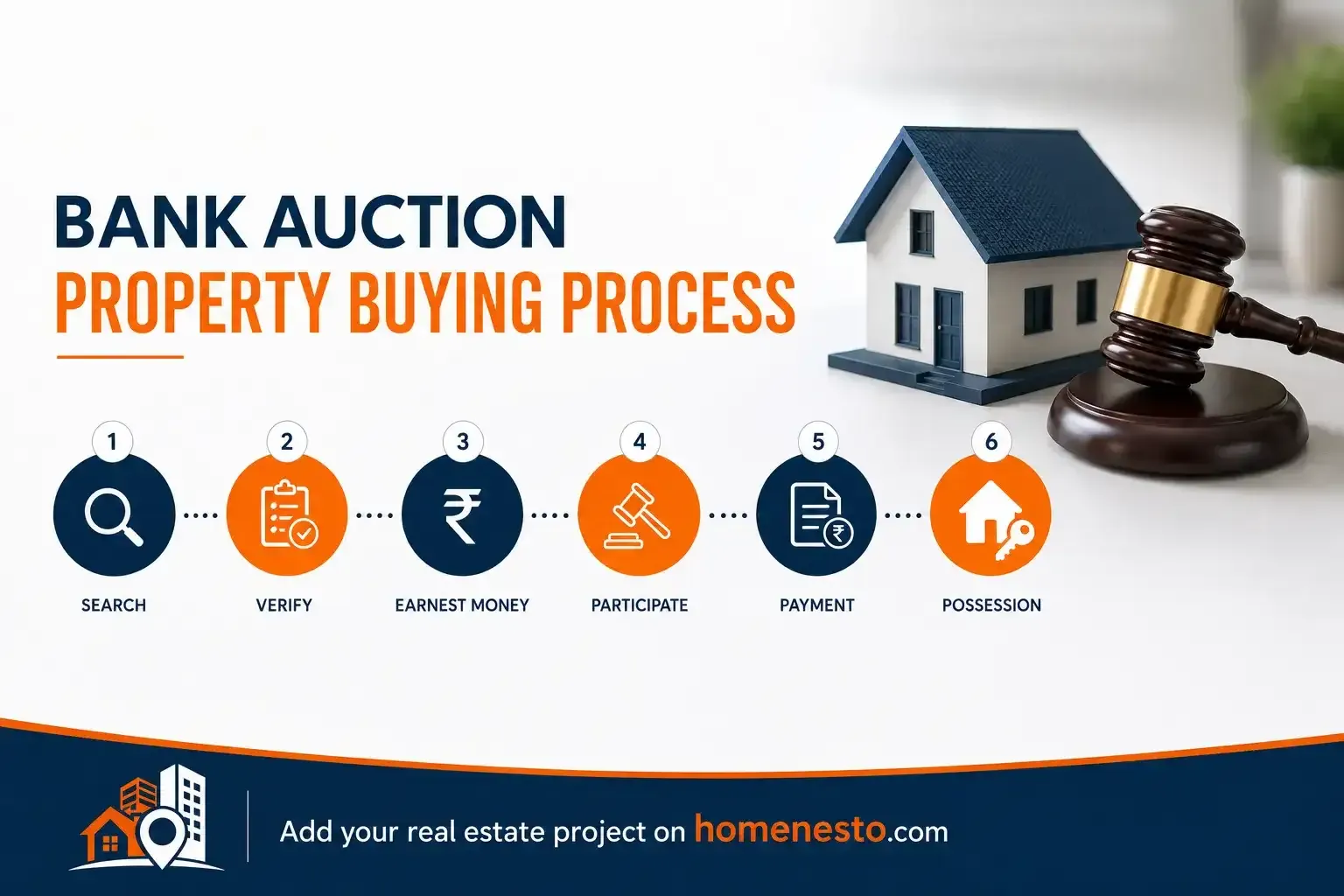
What You Need to Know About Bank Auctions
Bank auctions happen when borrowers default on loans. The bank sells the property to recover money. These aren't commercial deals—they're legal processes that follow strict rules. You get a real property at auction prices, but with responsibilities attached.
Properties available through bank auctions come in two main categories: Non-Performing Assets (NPA) and foreclosed properties. Understanding which you're bidding on matters because timelines and possession conditions differ.
Step 1: Understand Your Eligibility and Requirements
Before you start, check if you can actually participate. Most banks allow:
Individual buyers (Indian citizens)
HUFs (Hindu Undivided Families)
Companies and partnerships
Non-Resident Indians (specific conditions apply)
You'll need to open an account with the auctioneer's system. This usually requires basic identity proof and address verification. Some banks use online platforms like e-auction portals, while others conduct physical auctions or hybrid models.
Budget for earnest money deposit (EMD). This is typically 5-10% of the reserve price and shows the bank you're serious. If you win, this amount goes toward your purchase price. If you don't win, you get it back within a few weeks.
Step 2: Research and Due Diligence
This step separates smart buyers from risky ones. Never bid without doing your homework.
Physical Inspection: Visit the property personally. Note structural condition, encroachments, boundary issues, and neighborhood surroundings. Banks don't guarantee property condition—you buy it "as is." Taking photos and documenting issues helps if disputes arise.
Legal Verification: Check title documents carefully. Banks provide these in the auction notice. Verify:
Clear ownership history for at least 3-5 years
No pending litigation or court orders
Outstanding dues like property tax, water, or electricity bills
Encumbrance certificate status
Any restrictions on transfer or use
Market Value Assessment: Don't assume auction price equals market value. Compare with similar properties in the area. If the reserve price seems too low, investigate why—sometimes there's a catch (tenant rights, environmental issues, location concerns).
Tenant and Possession Status: Some auction properties are occupied by existing tenants or residents. Banks must inform you of this. Understand that removing a tenant can be lengthy and costly, sometimes taking months or years through legal processes.
Step 3: Prepare Financial Arrangements
You need money ready before bidding. This isn't like regular property purchases where you take time to arrange financing.
Earnest Money Deposit (EMD): Pay this upfront. Amount varies but typically ranges from 5-10% of the reserve price. Payment methods include demand drafts, bank transfers, or online portals depending on the auctioneer.
Total Cost Estimation: Budget includes:
Reserve price (the starting bid amount)
Registration and transfer fees (typically 5-6% of purchase price)
Legal fees for documentation (₹10,000-₹50,000 depending on property value)
Stamp duty (varies by state, usually 4-5%)
Any outstanding dues on the property
Possession charges if applicable
Financing Options: Most banks do provide home loans against auction properties, but the process differs from regular purchases. You typically can't get a pre-approval like in traditional home loans. After winning the bid, you apply for a loan immediately. The bank disburses funds after title verification and inspection. This can take 1-3 months, so you need to pay the balance in the meantime or arrange bridge financing.
Step 4: Participate in the Bidding Process
Bidding works differently than you might expect. There's structure and rules.
Online vs. Offline Auctions: Most banks now conduct online auctions through e-auction portals. You register, place bids electronically, and can monitor in real-time. Offline auctions still happen but are becoming less common. Some banks use hybrid models where physical auctions happen but with online participation options.
Bidding Increments: You can't bid any amount you want. Auctions have minimum increment values (often ₹10,000 or ₹1,00,000 depending on the reserve price). This prevents price manipulation.
Reserve Price and Opening Bid: The reserve price is the minimum the bank will accept. If no one bids above it, the auction closes. The opening bid is usually the reserve price itself.
Bid Duration: Auctions stay open for a set period—often 2-3 days for online auctions. In the final minutes, bids may extend the closing time (usually 5-10 minutes per bid in the final phase). This prevents bid sniping and ensures fair competition.
Step 5: Win the Bid and Pay the Balance
When you're the highest bidder at closing time, the property is yours legally. But you're not done paying yet.
Confirmation and Balance Payment Timeline: After winning, you usually have 7-30 days to pay the balance (depending on bank terms). This is when your financing comes in. If you're getting a loan, your bank processes the approval and disburses funds. During this period, you need to:
Get loan approval from your financing bank
Complete all inspections and verifications required by the lending bank
Arrange for remaining cash if loan doesn't cover 100%
If you can't arrange funds within the timeline, you forfeit your EMD and the property goes back to the originating bank. This is serious, so don't bid without confirmed financial capacity.
Step 6: Complete Documentation and Transfer
Once payment clears, the legal transfer happens. This involves multiple documents:
Sale Deed Preparation: The bank's lawyer and your lawyer draft the sale deed. This document formally transfers ownership. It includes property description, purchase price, and any conditions.
Registration Process: The sale deed must be registered at your local sub-registrar's office. This makes the transfer official and gives you legal ownership. Registration involves:
Payment of registration fees (typically 5-6% of property value)
Payment of stamp duty (varies by state)
Submission of documents to the registrar
Verification by registrar's office (usually completed within 1-2 weeks)
Getting New Title Documents: After registration, you receive updated title documents in your name. Keep these safe—they're your proof of ownership.
Step 7: Take Possession
Ownership and possession are different. You can own a property but not physically control it if someone else occupies it.
Vacant Possession: If the property is unoccupied, you take possession once registration is complete. The bank hands over physical keys and control. This usually happens within 7-30 days after registration, depending on bank procedures.
Occupied Possession: If the property has existing tenants or residents, the situation gets complicated. Banks must inform you of this upfront. Tenant removal requires legal process through courts, which can take 6 months to 2+ years depending on circumstances. Some buyers negotiate directly with occupants for compensation and faster vacation. This is a major cost factor to consider.
Important Considerations and Risks
No Warranty or Inspection Period: Banks sell auction properties "as is where is." If the roof leaks, walls crack, or plumbing fails the day after you take possession, that's your problem. There's no warranty period or comeback to the bank. This is very different from regular property purchases.
Tenant Rights: Existing tenants have legal protection. You can't just evict them. If a tenant has been occupying the property for years, courts often recognize their rights. Budget significantly for this possibility.
Title Defects: While banks conduct due diligence, occasionally title issues emerge after purchase. Rare but possible. This is why title insurance and legal verification are crucial.
Environmental or Legal Encumbrances: Some properties have restrictions (can't be used for certain purposes, environmental cleanup needed, etc.). These are mentioned in auction notices but easy to overlook.
Timeline Reality: From bidding to possession, expect 2-4 months minimum. If tenant removal is needed, add 6 months to 2 years. Financing arrangements can delay things further.
Why Auction Properties Are Cheaper
The discount isn't mysterious—it reflects real risks and complications. Prices are 20-40% below market typically because:
Properties are sold without warranty or guarantee
Tenants may not vacate easily
Title issues, though rare, do occur
You need ready capital quickly
No bargaining power—it's take it or leave it
Additional legal and procedural costs stack up
Smart buyers view this discount as compensation for these challenges, not as free money.
Financing Your Auction Property Purchase
Can you get a home loan? Yes, but process differs from regular purchases.
Which Banks Lend: Most major banks offer loans against auction properties. HDFC, ICICI, Axis, SBI, and others participate. Smaller banks and NBFCs also do.
Loan-to-Value Ratio: You typically get 70-80% loan against the hammer price (amount you bid). If you win at ₹50 lakhs, the bank lends ₹35-40 lakhs. You pay the remaining ₹10-15 lakhs in cash.
Processing Timeline: After winning, apply for loan immediately. Processing takes 3-8 weeks typically, depending on property verification and documentation.
Documentation Required: Same as regular home loans—income proof, financial statements, property documents, valuation report, and others. Auctions don't get preferential treatment in documentation.
Common Mistakes to Avoid
Mistake 1: Bidding Without Site Visit
Never bid on a property you haven't seen physically. Photos and descriptions lie. Visit multiple times, at different times of day, to understand the real condition and surroundings.
Mistake 2: Ignoring Tenant Information
Always clarify tenant status before bidding. If occupied and you ignore this, you're stuck with legal tenant removal later. This can negate your entire discount savings.
Mistake 3: Underestimating Additional Costs
Registration, stamp duty, legal fees, and any outstanding property dues add up quickly. Many buyers are surprised when total cost reaches or exceeds market price after these additions.
Mistake 4: Not Verifying Title Thoroughly
Just because a bank is selling doesn't guarantee perfect title. Hire a lawyer to verify property history, check for disputes, and confirm clear ownership transfer is possible.
Mistake 5: Bidding Without Financing Arranged
You have limited time to pay balance. If you're counting on getting financing post-bidding, coordinate with your bank before auction. Get pre-approval in principle for auction properties if possible.
Mistake 6: Overlooking Reserve Price vs. Market Price
If reserve price is 50% below market value, find out why. Sometimes there's good reason (real demand issue, location problem, specific defect). Cheap doesn't always mean good deal.
Timeline Summary: From Auction to Possession
Days 1-7: Research property, arrange EMD, register on auction portal
Days 8-10: Bidding period (typically 2-3 days)
Days 11-40: Balance payment and financing (7-30 day window to complete)
Days 41-60: Legal documentation and registration (2-3 weeks)
Days 61-90: Take possession and physical handover
Total: 2-3 months for vacant properties. Add 6-24 months if tenant removal needed.
Is Bank Auction Right for You?
Bank auctions work best for buyers who:
Have cash or confirmed financing ready
Can handle risk and complications
Are willing to do thorough due diligence
Don't need immediate possession
Can negotiate tenant removal if needed
Understand "as is" means as is
They're less suitable for first-time buyers who need hand-holding or those requiring quick possession.
Final Thoughts
Bank auction properties can be genuine opportunities if you understand what you're getting into. The discount is real, but it reflects real risks and work involved. Success requires patience, capital readiness, and thorough due diligence. Cut corners, and you'll regret it. Do the work properly, and you might land a solid property at good value.